Sunday, February 19, 2012

Finding Winter on Nippletop

The topic of conversation between everyone in the north country this year is the bare grass on everyone's lawn and the icy trails in the backcountry. Everyone keeps waiting for a big snowstorm to finally hit, to give the skiers and snowshoers just a few days of fresh powder, but it's starting to look like that may never happen. Three inches of snow was forecasted to fall three days ago, but temperatures stayed above freezing and brought rain instead to most of the north country. But surely it must be cold enough for it to snow somewhere, right? In the past few weeks I've been climbing peaks, expecting that at the very least the high peaks must have a snowpack by now. Last week I ascended Phelps in search if winter but found only numerous sections of steep ice, and green trees on top. Tabletop was much the same, with some snowpack on the ground but not on the trees. What makes winter hiking so beautiful though isn't the snow on the ground, it's the snow and ice on the trees that make the landscape so spectacular. A wintry landscape has been tough to find this winter, but yesterday I found that if you climb high enough, you can still find it.

Our group of 6 ascending Elk Pass
Yesterday I embarked on my first ever group hike, with a wonderful group of 6 people from the Adirondack High Peaks Forum, an informal group of people on-line who share information such as trail conditions and advice on outdoor gear. I've always been leery of group hikes, since I prefer to hike in solitude and spend a long time at the top of the peaks just taking it all in, whereas groups usually keep moving. But group hiking has its advantages, such as safety in numbers, motivation, and conversation to keep your mind off how many miles are left. In the winter the safety advantage is the best selling point for me, as I don't feel safe hiking alone in winter and in steep icy spots extra hands are a great help. I'm sure that some groups are better companions than others, but I have to say that I couldn't have asked for better companions in yesterday's hike up Nippletop and Dial. The group had such a great sense of comraderie, everyone helping each other across tricky spots,  keeping one another's gear in working order, and making sure everyone was in good spirits. And the pace was enjoyable, with enough breaks to keep the pain in check but few enough to make it back to the car in daylight. I've been converted, and hope to go on more group hikes (at least in winter) in the future.


Our hike was a 13.1 mile trip from the Ausable Club parking lot up Elk Pass (known as one of the steepest trails in the Adirondacks) up to the summit of Nippletop, down to the summit of Dial, then up and down a smaller peak known as Bear Den and lastly up and over the shoulder of Noonmark to loop back to the 

parking area. It can also be
View from top of Elk Pass
The summit of Nippletop looming ahead
 travelled in the opposite direction, but I'm really glad we chose to go the way we did, since the incredible experience on Nippletop made the entire hike worthwhile and gave me the motivation needed for the rest of the hike. At the parking area, where there was barely a dusting of snow on the ground, we all decided to leave our snowshoes behind because recent trail conditions haven't warranted using them. Everyone started the hike in microspikes, and about half of us wore crampons from Elk Pass to the end of the loop. While the microspike wearers were able to get by with the help of the people in crampons, I was happy that I paid $15 to rent crampons from EMS the day before, as it was definitely the best footwear for the icy conditions. Once we reached about 2000 feet in elevation there was a fresh layer of 3-5" of snow, which was a welcome comfort to the bottoms of our feet and made traction a little easier. When we started the steep climb up Elk Pass, it finally started to look like winter. At about 4000 feet the balsam and spruce trees began to be blanketed in snow, and in some places there were snow drifts up to a foot deep on the trail (turns out we could have used snowshoes after all). At .2 miles below the summit of Nippletop the trail diverges to Dial, and it was from this junction that the best part of the hike began. It was late morning and the sun was peeking through the clouds, making the snow sparkle on the trees. Here, at about 4400 feet, was our first sight of trees that had been encased in ice for weeks, with icicles hanging from their boughs and a fresh blanket of snow covering all the needles. This part of the hike was like walking through a crystal fortress, and I couldn't stop taking photos. Ahead of us we could see the pointed summit of Nippletop, poking out of the sky, with the snow-flanked slides of Dix right next to it. The view from the summit was incredible, looking out over the Great Range to the snow-capped slides of Gothics, the pure white summit of Marcy, and the trails of Whiteface, as well as countless other peaks. The sun was shining and the wind was calm, it was the perfect moment, and definitely the high point (in more ways than one, as we were at 4600 feet) of the day.


Panoramic view from Nippletop's summit

Having reached our highest destination the hike was far from over, as there was still 6.5 miles of up and down hiking left. We descended to the col between Nippletop and Dial, with great views of Dial ahead of us. The summit of Dial is just a single large boulder that affords a nice view of the great range, which had begun to be obscured by clouds by this time of day. After a few photos we continued our descent, which involved climbing over two more smaller peaks, neither of which were easy with our tired feet. We anticlimactically climbed over the hump of Bear Den Mtn, which had a sign at the summit but no view. The hardest part of the hike was climbing up over the shoulder of Noonmark, which itself is just shy of high peak status and has very steep sides. Climbing up over the bare rock shoulder, recently cleared by a forest fire, took every bit of energy I could muster, but at least from there it was finally all down hill, though the last 3 mile descent was frustratingly icy and slow going. After 9 1/2 hours of hiking we made it back to our cars, a long exhausting day, but well worth the effort.

View from Dial's summit with clouds rolling in


People who know me and know my dislike for winter are baffled by the fact that I've been climbing so many mountains this winter. It's true that as much as I love the outdoors I usually hibernate through the winter, happier to be in a warm house than out in the bitter cold. But since my first wintry climb back in November in the White Mountains, where I saw snow-capped twisted balsam trees for the first time, I have a whole new outlook on winter. I have a hard time putting the experience of walking in the alpine zone when everything is covered in snow and ice into words, and the only words that come to mind are ethereal and spiritual, like you've entered another world. I never thought that I, of all people, would work so hard to seek out winter at 4600 feet, but sometimes life surprises you.

The unwelcome view of Noonmark's shoulder, our final climb
The slides of Dix
Trail below the summit with Whiteface in the
background


Saturday, February 4, 2012

Cascade in Winter

Nearby Porter Mtn with Algonquin in
 the background
Last week I set out to climb Cascade Mountain, the easiest and most accessible of the 46 Adirondack high peaks. With a trailhead that is located right on a state highway and starts halfway up the mountain, Cascade is arguably climbed by more people than any other high peak in the Adirondacks. The climb up Cascade can instill a false sense of confidence to aspiring 46ers, since it is only 2.7 miles to the top and lacking any really steep pitches. It is quite the contrast to the the other high peaks, most of which require at least 10 miles of hiking round trip, and many of which require some hand-over-foot climbing to reach the summit. Of course, ease of difficulty is all relative to the person's climbing experience. I have to admit that the first time I climbed Cascade, shortly after moving to the Adirondacks 11 years ago, I would not have described the hike as "easy", and certainly found it a challenge to make it to the top. I suspect that many of the Lake Placid tourists who attempt Cascade as a leisurely family hike would say the same. But for those of us who've hiked so many other peaks, Cascade really is just a leisurely walk compared to the other peaks, which makes it the perfect peak to climb in wintry conditions.

Ice rime on the trees near the summit
I have to admit that I have never been a fan of winter hiking, and usually can count on one hand the number of mountains I climb in a winter. On cold snowy days sitting by my fireplace with a good book just sounds so much more comforting than navigating snow and ice to reach a peak where its unlikely that the snow showers will break long enough for me to have a view. Not to mention that I have very little tolerance for cold, and after a winter hike I'll be chilled to the bone for days. I've never been able to see the draw to winter hiking, since a landscape covered in snow just isn't as exciting as a summer landscape full of life. It took a friend of mine dragging me up one of the White Mountains in November for me to realize the draw of winter hiking to reach snow-capped summits. Reaching above treeline and looking down at a stand of stunted balsams so covered in ice rime that they look like a crystal fortress is really a surreal experience, and creates a much more interesting view than a landscape covered in green. In the summer every minute of my hike is exciting because I'm always taking note of a bird singing, a wildflower in bloom, or a mushroom at the base of a tree. Winter isn't as full of life, but the snow still tells a story that I can read as I pass through. Tracks in the snow tell me that there is life--like grouse, marten, squirrels, and hares--but that I just don't see it because my footsteps crunching the snow loudly warns them of my presence.


The final rock scramble to the top, bare in late January
Another advantage to winter hiking is that it is much easier to find solitude in the mountains, especially on a weekday. Even in winter the trailhead to Cascade fills with cars on the weekend, but mid-week there may only be a few cars if any. I chose a fairly warm, clear day for my hike, and so I was not entirely alone but passed only a couple of others on my way. In winter I actually prefer the company of others for safety, since the likelihood of falling is much higher in winter, and especially in this winter. This has been a very poor winter for snowy activities, with each snowstorm being followed by a warm front that reduces the snowpack to ice almost immediately. The entire trail to Cascade was a sheet of ice, and I feared that the final scramble to the top over bare rock would be too icy for the gripping ability of my microspikes. On the way up I passed a hiker with a pair of snowshoes and a set of crampons in her pack, but she informed me that she never used anything other than microspikes to reach the top. I wondered how that could be, but when I came to the final rock scramble I saw the reason why--rather than being covered in ice the rock above treeline wasn't covered at all, it was mostly bare. This was quite a shocking discovery for the middle of winter in the Adirondacks, and made my final ascent fairly simple. I met another hiker near the top and he was simply hiking in bare boots, no traction devices necessary (he was also only 2 peaks shy of becoming a winter 46er). I was exhilarated to reach the top, as it seems I have only about a 50/50 success rate with winter hikes, often choosing to turn back if I reach a steep pitch. Just last week I didn't even make it to the top of little Owl's Head because of one steep section near the top, a result of too much ice and not enough snow. I suppose that the purchase of some crampons and an ice axe would expand my winter hiking capabilities, but with winter more than half over I think I'll save that investment for next year. Usually my snowshoes would be sufficient for the peaks I wish to climb, but with the lack of snow all I've been able to do so far this year is carry them around in my pack in the hopes that I find enough snow to wear them.

View from Cascade, Left to right is the Great Range, Marcy, Algonquin and Wright.

If you've never ascended a peak in winter, I highly recommend Cascade for an incredible view of the high peaks and Lake Placid below. The 360 degree view is amazing any time of year, but in winter I think it's really special. Such a hike does require purchasing microspikes or snowshoes, but it is well worth the investment and opens up the possibilities for many other hikes. Winter hiking is certainly more challenging than other seasons, but the key is just to go slowly and think about every step. You'll get there eventually and it will be well worth the extra effort.

270 degree view from Cascade with the village of Lake Placid on the right

Sunday, January 22, 2012

Bloomingdale Bog--A Boreal Bird Hotspot


In the winter Bloomingdale Bog is hands down the best trail to walk in all of the Adirondacks. Its use by snowmobiles keeps the trail packed down so that skis and snowshoes aren't even necessary, you just have to choose times such as early morning or during the week to avoid the snowmobile traffic. On our walk yesterday we didn't come across any snowmobiles until after 10am. A winter visit won't have as many birds as a summer visit, in fact you're likely to only see a handful of species, but the many boreal specialties are still present and are easier to spot in the winter. The best place to see these species in winter is on Bigelow Road, a seasonal road off of Oregon Plains Road that provides a more open view and more upland habitat than the main bog trail. This was the route we took yesterday, and we had much success. 

First I have to apologize for the lapse in postings on account of the fact that I was away from the Adirondacks for the past two weeks, vacationing in the southwest. I wanted to blog about the amazing mountains of Nevada and California, but it didn't seem as that would be appropriate for a blog about the Adirondacks. Maybe on another blog...

While I haven't had the chance to get my snowshoes out and tackle any peaks yet, I did have the opportunity to lead a walk for the Northern New York Audubon Society yesterday to one of my favorite places--Bloomingdale Bog. In fact it ranks as my second favorite place in the Adirondacks behind Stony Pond. While there are larger and more scenic bogs than the one in Bloomingdale, it is by far the most easily accessible of our lowland bog complexes, and the first large bog I ever visited. Bloomingdale bog isn't an ADK maintained trail, so you won't find it listed in any of the the ADK guides, which helps limit the amount of use on this trail. It is one of the few trails of its size that is more popular with locals than with park visitors, as it's miles of flat trail provide a great spot for leisurely walks, and is a great place to bring dogs. It is also widely known as a mountain biking trail, and in fact George W. Bush was seen mountain biking here last summer. In the winter the flat grades make this a perfect trail for winter activities such as skiing, skijouring, and snowmobiling. But what really makes this bog unique from the other trails in the Adirondacks is something few of its visitors realize--that it is one of the best places in the Adirondacks to see boreal birds.

A Pitcher Plant, which traps insects to
 obtain the nutrients that it can't get from
 the acidic peat
In the Adirondacks the term boreal refers to habitats that have the same composition as the boreal forests of Canada, a habitat which extends south to just a few places in the northeastern states. These boreal habitats consist of lowland bogs where the presence of peat creates acidic conditions where only certain plants, such as heath shrubs, tamaracks, spruce, and pitcher plants, can survive. While the lack of nutrients in the soil limits the biodiversity in these habitats, the species that are found there are specialized to the harsh conditions and therefore many of them are not found anywhere else. In the Adirondacks our boreal forests are found mostly at low elevations, though a few patches can be found on some of the high peaks. The largest amount of boreal habitat is the western Adirondacks, where large bogs like Spring Pond Bog and Massawepie Mire stretch for miles. Bloomingdale Bog isn't as large as these, but it's location more central to the Adirondacks and the fact that an old railroad bed crosses right through it make it the most accessible bog in the Adirondacks. Despite its smaller size it is still large enough to support most of the species of plants and birds that one would find in the larger bogs.

Bloomingdale Bog in the summer
Spring and summer are definitely the best times to visit Bloomingdale Bog in search of birds, as there are dozens of species breeding there. The trail following an old railroad bed traverses a number of habitats ranging from cattail marsh on its western side (which begins on rte 86 north of Saranac Lake), to an open bog mat about a mile in, to an alder swamp that gradually changes to upland conifer forest on its eastern edge (After crossing rte 55 just north of Bloomingdale). Such a walk is about 5 miles long, and is best done with cars parked on either end of the route, though I like to visit a different part each time I go rather than walk all the way through. Each habitat brings different breeding birds such as Canada Warblers, Olive-sided Flycatcher, Lincoln's Sparrows, Palm Warblers, Ruby-Crowned Kinglets, and Yellow-bellied Flycatchers. The bog in early summer is alive with the songs of warblers and sparrows, but is also alive with black flies and mosquitoes, making fall and winter more popular times to visit.


A male White-winged Crossbill, which migrates south from boreal Canada
when cone crops are poor further north
Boreal Chickadees are one of the species that birders visiting the Adirondacks always hope to see, but they are much more elusive than their Black-capped cousins, and you need a little luck to get a good look at one. Yesterday luck was on our side, though, and we had amazing looks at not just one, but two boreal chickadees. Both birds came out of the thick spruces to feed on seeds in a bare branched tree just a few feet above our heads, a rare treat. Shortly after that we were treated to a sighting of another elusive bird--the White-winged Crossbill. These birds only visit the Adirondacks in some winters, and usually in fairly small numbers. Even when they are abundant they are usually seen or heard quickly flying overhead, and are rarely seen up close. Yesterday I used a pishing sound to draw in a pair of male and female crossbills, who cooperatively perched at the tip of a nearby spruce for about 5 minutes. This was plenty of time to admire their criss-crossed bills, which they use for prying seeds out of cones. Also present in the bog yesterday were hundreds of Pine Siskins, which continue to be abundant this winter. We finished our walk with a short visit to the bog trail, where we knew the Gray Jays would be waiting for handouts. We only saw one, but it approached us immediately for some handouts.

The Boreal Chickadee is common in boreal Canada,
but is only found in small numbers in a few U.S. states

In most birder's books a day of birding with only 8 species would be a disappointment, but on a single-digit snowy winter day 8 species is pretty good, especially when we had such good looks at rarely seen species. The three hardy souls that came out for the walk, all residents of the Adirondacks and active birders, had never seen either a Boreal Chickadee nor a White-winged Crossbill, so it was surely a rare treat to see them so up close. Experiences like that are why Bloomingdale Bog is my favorite Adirondack birding spot at any time of the year.

Friday, December 30, 2011

Christmas Bird Counting

My favorite part about the holidays has nothing to do with the holidays themselves. Sure, I enjoy pulling out my Christmas music to decorate the tree, watching people's faces light up when they receive my gifts, and spending time with family and friends that I rarely get to see, but the part that I look forward to the most is the time I spend with fellow birders on the holiday tradition known as the Christmas Bird Count.

It may sound like an odd holiday tradition, but the CBC as its called for short is one of the earliest movements toward bird conservation in this country, and has created the longest-running database of bird distribution in North America. The CBC was started in 1900 as an alternative to a long-standing tradition of hunting birds on Christmas Day, where the goal was to shoot as many birds as possible to win. An early conservationist realized that bird populations could not sustain such a tradition, and created the count tradition to draw people away from hunting the birds. Over the years the count has slowly spread across the country, with volunteers coming together to start their own count in communities nationwide. The National Audubon Society organizes the count each year, though the majority of the work is done by local count compliers who organize the volunteers in their own circle. The CBC is a volunteer-run effort to count birds within a predetermined area year after year between December 14th and January 5th to determine the presence and distribution of birds in circles across the continent. t. Count circles are 15 miles wide and are usually centered around a city in a way that includes both residential areas and birding hotspots, as both are equally important to determining how bird populations are adapting to changes in the landscape due to human activity.Thousands of birders commit to spending an entire day during the busy holiday season to help with the effort, and many birders partake in more than one count. Most volunteers commit to birding from dawn until dusk, with some eager birders even starting before dawn in the hopes of catching owls before first light. Volunteers are drawn to the count for a reason to get outside, the hopes of seeing an unusual species, and the fun of gathering with fellow birders at the end of the day. The number of volunteers in each circle varies greatly, but even in lesser populated areas at least a dozen birders can be expected to join the effort. When twelve birders spend 8 hours each looking for birds, it's amazing what kinds of species they often find. At the evening gatherings of volunteers that follow everyone is always eager to find out who had the biggest surprise, or the rarest bird, on that day.
Getting up at sunrise has its perks, this was the sunrise over Lake Champlain on the day of the Plattsburgh CBC

I've been participating in CBC's since I learned what one was, just after I graduated college in 1998. I remember how excited I was to get out and look for birds and contribute my findings to the long-running database. My first count was the Rennssalear CBC just outside of Albany, NY. I had recently joined the Hudson-Mohawk Bird Club, which was full of expert birders who were eager to share their birding skills with youngins like me. Many of the club members volunteered for the count, and were undoubtedly more skilled than I was at bird identifictation. I had only been birding for a little over a year, having taken ornithology in my junior year of college. But expert birding skills aren't needed to help with a CBC, since the majority of birds that one counts in the northeast are common feeder birds such as chickadees and house sparrows. Our best bird of the day was a Cooper's Hawk that we saw perched on a log with its lunch, a chickadee, in its talons. Not bad for a pair of beginner birders on their first CBC.

A Red-tailed Hawk on the Plattsburgh count
Since then I've participated in counts in a number of places in NY, but the ones I've participated in the most are the ones in Plattsburgh and Saranac Lake. These two counts are undoubtedly some of the coldest and snowiest counts in the U.S., and are not for less hardy souls. While much of the count can be accomplished from the warmth of a heated car, there is always walking to be done as well. This year's Plattsburgh CBC was the coldest one I've done yet, on December 18th, with a morning temperature of only 2 degrees. The temperature reached into the teens by mid-day, but the wind made sure we stayed nice and cold regardless. Cold snaps like that aren't the best for seeing birds, as many species would be less active on cold days, and some lingering migrants may finally push out as the cold front comes in. But it wasn't a bad day for me and my birding partner, as we managed to find 34 species that day, the most I've ever had on the Plattsburgh count. The species we found included 2 lingering loons, 5 bluebirds, a hardy Great-Blue Heron, and a flyover Plieated Woodpecker. The best bird of the day (and possibly of the whole count circle) was undoubtedly the Yellow-Rumped Warbler that we found in someone's front yard. Warblers are insectivores, and as such usually migrate south in late September and early October to places where the insects aren't frozen to death. In the 39 years of Plattsburgh counts this species has only been recorded one other time. The fact that it remains here now is likely due to the mild winter that we have had thus far, where I was seeing insects on my hikes as late as mid-November. But with the recent cold weather, I hope this little warbler has the sense to leave soon, as there won't be any insects around here for another few months.

Birders cover everywhere they can in the circle, including this airport
 in Charleston, SC, which was a good spot for grassland birds
When one gets up before dawn and spends an entire day birding one expects that they will be rewarded with good species of birds every time. In twelve years of CBC's I can assure you that for every exciting count I've done I've had another not-so-exciting count. One year I spent the day snowshoeing 7 miles in a snowstorm for the Saranac Lake CBC, only to have a total of 8 species for the entire day, the fewest I've ever had. Due to it being one of the coldest places in the continental U.S. the Saranac Lake CBC has less diversity that most counts, and most years I count between 15-20 species in my territory. On the Plattsburgh count I usually have a twenty-something species. The most exciting count I ever did was last year, when my work had me in South Carolina during CBC season. Having only ever done CBC's in upstate NY, counting birds in an area where all the birds migrate to for the winter was a completely different experience--there were birds everywhere and I could feel my fingers the whole time! At the end of the day we had 76 species, and for me every one of them was exciting. We birded in a variety of places including a residential development, an airport, and a saltmarsh along the river. There were so many birds it was a challenge to count all of them, and I'm sure that a few were missed. In NY that never happens, as birds are usually seen in small numbers and the only challenge is determining how big the flock of chickadees is every time you hear one calling. As much as I love helping with the counts in my own community, I hope I can get away to do another warm-weather count in the future.


While most people will be ringing in the new year recovering from the prior night's festivities, I'll be ringing it in with, you guessed it, counting birds. The Saranac Lake CBC is on New Year's Day this year, and I'll be out there at sunrise looking for birds. This year should be a good count, and I have a feeling that I'll break my Saranac Lake CBC record this year (which is only 17 species) with the amount of ducks that are still hanging around and the number of finch species that have invaded the north country this year. I'm excited that the forecast is calling for temperatures in the 30's, which is warmer than most counts I can remember. And the best part, what I look forward to most, is being able to see all my birder friends afterward, in a gathering of merriment where we share birding stories from the past year as well as the day's adventures. In a world where birders are a rarity themselves, I always enjoy being surrounded by people with the same passion as me, who will laugh at my bird stories because they understand. It's a fitting end to the holiday season, and I'll anxiously look forward to next year.

Thursday, December 15, 2011

Hurricane Mountain

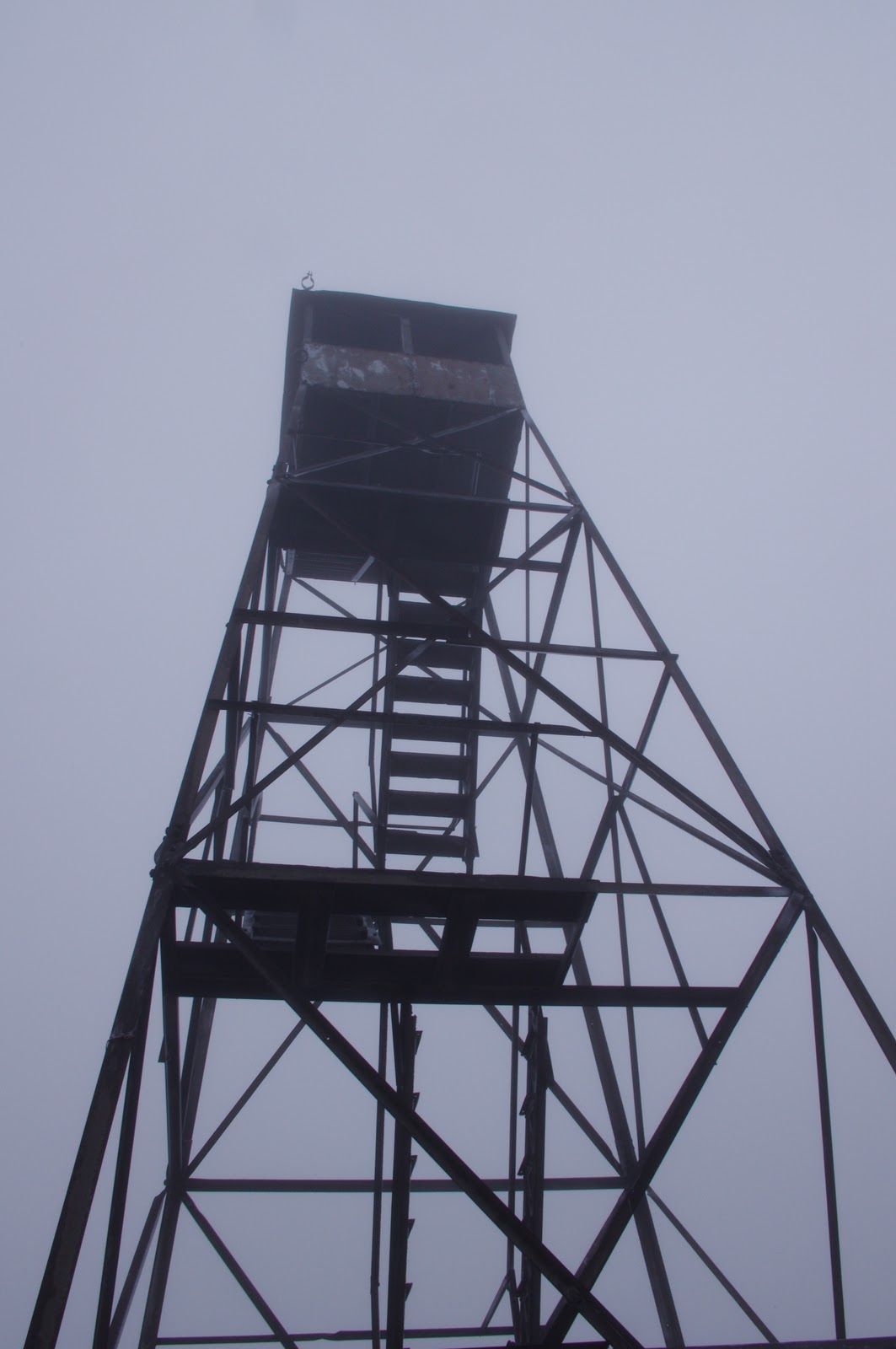
The firetower on Hurricane Mtn.
In an effort to keep my hikes close to home I've done a number of small hikes in the past week, almost all of which have been in or adjacent to the Hurricane Mountain Primitive Forest. For those of you unfamiliar with the terminology of forest units within the Adirondack Forest Preserve, the term "primitive forest" is used to describe an area that has most of the qualifications of wilderness, but  cannot classified as wilderness due to the presence of man-made structures within the unit. The presence of a fire tower, built in the early 1900's, is the key reason for the area's designation as "primitive" rather than "wild". Firetowers are a controversial subject in the Adirondacks, causing an endless debate over whether they should be preserved for historical reasons, restored for recreational use, or removed to return the area to a "forever wild" state. I, myself, don't really have an opinion on this matter, as I see valid points from each side of the argument. Part of me supports the idea of keeping the Adirondacks as wild as possible, but another part of me recognizes that the fire towers are a key part of Adirondack history. A few years ago I helped with the restoration of the fire tower on Lyon Mtn., one of the few towers that are still maintained for public use. So I really can't pick a side on this issue, and tend to think there are far more important issues in the Adirondacks that we should worry about.

A dusting of snow on the old logging road
On some mountains a fire tower is necessary in order to obtain a 360 degree view of the surrounding peaks, but on Hurricane Mt. no tower is needed for an amazing view. Many summits in the Hurricane Mtn. forest are bare rock at the top, a result of forest fires that ravaged the area in 1908, burning  20% of the forest preserve. The advantage to this is that many of these mountains, despite being only 2500-3500 feet high, offer astounding views of the greater mountain ranges around it. From the summit of Hurricane one can see the Jay Mtn. range, Giant Mtn. Wilderness, the Great Range, Whiteface Mtn., and the Green Mountains. Unfortunately the day that I chose to climb the peak last week afforded little in the way of a view, as a cold front of clouds and snow came rolling through as we made the ascent. The view was still impressive though, creating an ethereal view of Giant Mtn. as an island in a sea of clouds that would come and go as the clouds rolled past. While being able to see hundreds of peaks is always rewarding, there is something equally exhilarating about being in the clouds, surrounded in mist, watching a front roll in. Hurricane Mtn. tends to live up to its name by being extremely windy due to its isolation from other peaks, as I've experienced the other two times I've visited. But on this day the wind was calm, just an occasional light breeze pushing the clouds through, adding to the surreal feeling of being in the clouds. While we sat at the top a light snow began to fall, leaving a slight dusting on the trees that we admired on our way down the mountain. While I've always preferred any other season over winter, days like that are giving me a new appreciation for the season.

Ethereal view of Giant from Hurricane Mtn.
There are three ways to ascend Hurricane--Crow Clearing, Route 9N, and Hurricane Mtn. Road. We chose the Hurricane Mtn. Road route, the least popular of the three. This trail starts on private land and traverses an old logging road for about a mile before it starts to climb. The trail was a little slick in spots due to ice, but overall very manageable. There was a large amount of fallen trees along the trail, some of which looked fresh from hurricane Irene, and some of which is probably from the ice storm of 1998. Whatever the cause, they had all since been cleared from the trail itself leaving no obstacles to climb over. Another friend of mine hiked the Route 9N trail the next day, the most popular route, and reported that it was very wet. Last year I hiked in from Crow Clearing, and I think this is the most scenic route. The trail crosses back and forth across a stream for much of the way before ascending through a thick balsam forest up to the summit. From this same parking area there are three other shorter hikes that can be added to a trip up Hurricane, or done on their own. Last year I hiked to Lost Pond after ascending Hurricane, a small picturesque pond perched on the side of the mountain. Yesterday I returned to that area to hike to Big Crow, a short but steep hike to an exposed rocky summit that overlooks Keene and the Great Range. It was another overcast day, but breaks of sun shone light on the valley below and made the ice-coated trees on the summit shimmer, creating some great opportunities for photos. From there one can continue to hike to Little Crow, about 400 feet below, but I chose not to do so yesterday because much of the bare rock descending Big Crow was covered in ice, making footing challenging.

View from Big Crow Mtn.


Hurricane Mtn. from Owl Head Lookout
One advantage to keeping the firetower on Hurricane is that it makes the peak easily recognizable from the top of other peaks. Last week I easily identified Hurricane from the summits of Baxter Mtn. and Owl Head lookout, two peaks that lie in the Giant Mtn. wilderness just beside Hurricane. Even though the firetower no longer serves a purpose, as its use was discontinued in the 1970's, it plays a part in the character of Hurricane Mountain, and I'm not sure the mountain would be the same without it.

Tuesday, December 6, 2011

Backyard Birds

Okay, I have to admit that I haven't been hiking at all this past week, leaving me at a loss for adventures to blog about. But that's okay, because I've been waiting for the right time to write about the wildlife oasis that is my backyard, because there have been many memorable moments right outside my dining room window. My backyard has numerous attractions to wildlife--a flowing stream, open fields, shrubs for cover, an adjacent wilderness area, fruit trees, perennial flowers, and plenty of bird feeders. Most days I can see more birds here than I would see if I hiked ten miles through the forest, so you can't blame me for choosing to relax at home once in a while and watch the birds from the comfort of my warm home. I can reliably expect a good number of species here, and once in a while I'm met with some surprises.

A Black-capped Chickadee that I banded
I suppose I should start with the species that have become regular visitors to the yard, some of which I've grown rather fond of since moving here last year. Each morning starts with the chickadees, who arrive just after sunrise each morning in a small flock, taking turns at the feeder (they do, in fact, have a pecking order when it comes to feeding). Chickadees come and go in small flocks throughout the day, making it impossible to know how many there are. The only way to really count them is to capture them and band them, a project I started last week. Using a fine mesh net called a mist net I captured three of my resident chickadees last week and gave them each a shiny bracelet with a USFWS number so they can be tracked if caught again. I've seen at least two of them revisit the feeder, and suspect that there may be dozens more for me to band. That'll be a good project for me this winter.

The next birds to visit are usually the Blue Jays, which loudly announce their presence, and usually only stay at the feeder for a short while each morning and again in the afternoon. Occasionally we will see a woodpecker at the suet, usually a Hairy Woodpecker. I've seen Pileated Woodpeckers in the yard, always a magnificent sight, but they're a little big for my small suet feeder. Lately the only other regular species has been a small flock of American Goldfinches, who like to sit on the feeder's perches and gorge themselves on sunflower seeds.

The Gray Catbird, feasting on crabapples
The regulars are a welcome sight at the feeders, but what really makes this yard exciting is the surprising rarites that pass through. Last week I was sitting at my computer when I heard a familiar meow-like call from outside, which was coming from an appropriately-named Gray Catbird that was sitting in my crabapple tree. Gray Catbirds are rather common birds of shrubby areas in more southern parts of the state, but in the Adirondacks they are an uncommon sight. Seeing one at the end of November is a very rare sight, and it's likely that this was a young bird that flew a little off course from it's migration route south. The confused bird stayed in the yard for five days, then disappeared when a cold snap came through. Hopefully it put on enough weight eating my crabapples to make the rest of its journey.

A Ruffed Grouse surprised me this evening
A few days before the catbird arrived I had a visit from a Ruffed Grouse, who was likely also attracted to the berries on my crabapple tree. In my experience crabapple trees are by far the best way to attract birds to the yard, as I have had a number of rare birds in that tree. Last winter the tree was picked clean by flocks of Cedar Waxwings and Bohemian Waxwings, who depend on trees that bear fruit in winter as their main food source. One day last year the alarm calls of Blue Jays alerted me to a Northern Shrike that was perched in the crabapple tree, a predatory bird that is seen in small numbers here in winter, and rarely seen in backyards. It was likely looking to pick off one of the chickadees or goldfinches from the feeders, but the Blue Jays drove it off as soon as it arrived. This was definitely the most exciting bird I've seen in the yard, and wish I had time to snap a photo before it left.

A Bohemian Waxwing in the crabapple tree last winter

The Black Squirrel
While the birds come and go, there are a variety of mammals that have become regular visitors here as well. A herd of deer is often seen in the fields behind the house, and they cross through the yard to reach the stream down below. A few weeks ago they were in the yard a few nights eating some of the fallen fruit from an apple tree that I have on the edge of the woods. We have excellent rodent diversity here, with at least four species living in or near the yard. There are chipmunks, mice (who are unfortunately sighted inside the house too), red squirrels, and gray squirrels. The star attraction of the yard is a female "black" squirrel that visits almost daily, which is an uncommon color morph of a gray squirrel. She usually visits the feeders just before or after a male gray squirrel visits, so I assume that they are a mated pair. They disappeared for most of the summer, off raising young I assume, but returned about a month ago and have been seen under the birdfeeders daily ever since.


As I write I can hear the chip notes of chickadees outside, an almost constant sound this time of year. The crabapple tree is still full of bright red berries, awaiting its next visitor. There haven't been any sightings of waxwings yet this winter, so I'm not sure if they'll come down from the north this year. I'm hoping to see a Pine or Evening Grosbeak in the tree this year, since they are predicted to come south this winter. Stay posted for the next rare sighting...

Tuesday, November 29, 2011

Snow Goose Migration

While I love my home in the Adirondacks, there is one thing that I definitely miss about living in the Champlain Valley--the migration of Snow Geese. Each spring and fall thousands of Snow Geese stop in the corn fields adjacent to Lake Champlain to refuel for the rest of their journey. In the spring their final destination is the arctic tundra, a flight worth making to reproduce because there are few predators in far northern climates. In the fall their final destination is the southern United States and Mexico, where they winter in farm fields and grasslands. When I lived in the Champlain Valley the Snow Geese were the true sign that the seasons are about to change, migrating in the first days of spring and the last days of fall, timing their arrival to just avoid the snowfall. These birds take their time reaching their destination--unlike small songbirds that can fly hundreds if not thousands of miles in a few days these larger birds fly much shorter distances before needing to refuel. They stop in numerous fields on their way south, hoping to find fields such as the one I saw them in yesterday,which was a recently plowed cornfield full of broken corn cobs. They'll stay as long as they can to pack on weight for the next leg of their journey, and push on when the weather changes.

There are about 3000 geese in this shot.
What makes Snow Geese such an amazing sight to see is the sheer numbers in which they migrate in, covering the fields so well that from a distance they look like a blanket of snow themselves. Adult birds have strikingly beautiful white plumage, with black outer primary feathers that make them easy to distinguish from other waterfowl in the air. Young birds are less white, with dusky gray feathers throughout. Mixed in with these beautiful white birds are the less common "Blue Goose", which look like another species all together but are simply a bluish-gray color morph of  the same species. Adult blue morphs have a pure white head and neck, contrasting beautifully with the darker body, while the juveniles are entirely dark gray. In the flocks that I saw yesterday there was maybe one blue goose for every hundred white geese.


When the geese arrive in the Champlain Valley they move between the fields each day, staying mainly in the fields between Rouses Point and Chazy. When I lived on Conroy Farm in West Chazy, I anxiously awaited the day each year that the geese would land in the cornfield behind my house, so I could watch them from my upstairs window. One year I spotted a rare Greater White-Fronted Goose from my window, a real treat. So it was fairly ironic that when I went looking for the Snow Geese yesterday I happened to find them right on the Conroy Farm, and in much greater numbers than I was expecting this late in the season. Right across from Conroy Organics was a flock of about 5000 Snow Geese, and there were another 1000-2000 birds in adjacent fields as well. I watched them for over an hour, admiring their beauty, snapping photos, and looking for banded birds. An organization in Nunavut, way up in the Arctic Circle, has been banding the snow geese on their breeding grounds for years, and I have tried to do my part to report the bands I see when they pass through. The bands are placed on the neck so that they can be read easily from a distance, if you have good eyes for that sort of thing. Straining my eyes to read the bands yesterday brought back memories of a job I had this spring reading color bands on Red Knots, a small shorebird whose bands are about a tenth the size of the ones used on geese and much more challenging to read (picture below). I think that job actually did help my resighting skills, because I was able to read 4 distant band combinations yesterday just using my inexpensive spotting scope. On the Red Knot project we used top-of-the-line scopes that cost a few thousand dollars, but reading such small numbers was still very difficult. Today I reported the band numbers from the geese to the USGS bird banding lab and researchers at Laval University, who oversee the project. Immediately I found out that all 4 birds were females, and that two of them were just banded this year. The oldest bird that I reported was banded in 2007, and had been resighted three times since being banded, including one sighting in NY in the spring of 2009. My sighting was the first record of this bird for the past year, which makes my sighting crucial to the researcher's goals of determining survivorship.

A Red Knot with color bands--the three digit code is on the green band.
While watching the flocks of geese yesterday I was a little disheartened to hear the sound of gunshots just a few fields away, which scared about 1000 geese into the air to land in the field I was watching. While I appreciated being able to see and photograph the geese in flight, it saddened me to think about these beautiful birds being shot. I'm not opposed to all hunting, but don't understand why a hunter would choose to  hunt a snow goose when there is a greater need to control the population explosion of Canada Geese, which were also in fields nearby. Sadly it is a common sight to see a bird whose plumage is washed in blood due to a gunshot wound, and yesterday I did see one bird with a gunshot wound on its neck. I always appreciated that the Conroy Farm had "No hunting" signs posted to protect the geese, one of few fields where they aren't in danger from hunters.

Snow Geese up close, including white adults and grayer juveniles. Can you find the Blue goose in this photo?

When I lived on the farm the sounds of Snow Geese flying overhead would last a few weeks in the fall, and then the quiet of winter would set in. I miss the sound of those flocks now that I'm nestled in between mountains. But I'm glad I had the chance to see them at least once along their journey, and look forward to seeking them again in the spring.